What are they doing?
Each person runs their own agents in their own tools. There's no shared view across the organisation.
Private beta · accepting design partners
Corenote is the shared workspace where your team delegates work to AI agents, reviews submissions backed by evidence, and keeps a permanent record of who approved what.
The future of work
Work is shifting to teams of people and agents. Corenote is the collaborative super agent that holds them together: it plans the work, hands each task to the right person or agent, and keeps a person in the loop wherever it matters.
The problem
People across your organisation run their own agents, in different tools, on different work. Work gets marked “done” with no owner, no evidence and no approval. That’s invisible autonomy.
Each person runs their own agents in their own tools. There's no shared view across the organisation.
Agent work isn't tied to a goal, a team or a person, so work gets duplicated.
An agent saying “done” is a claim, not a decision. Without an approval on record, nobody’s accountable.
The Acceptance Loop
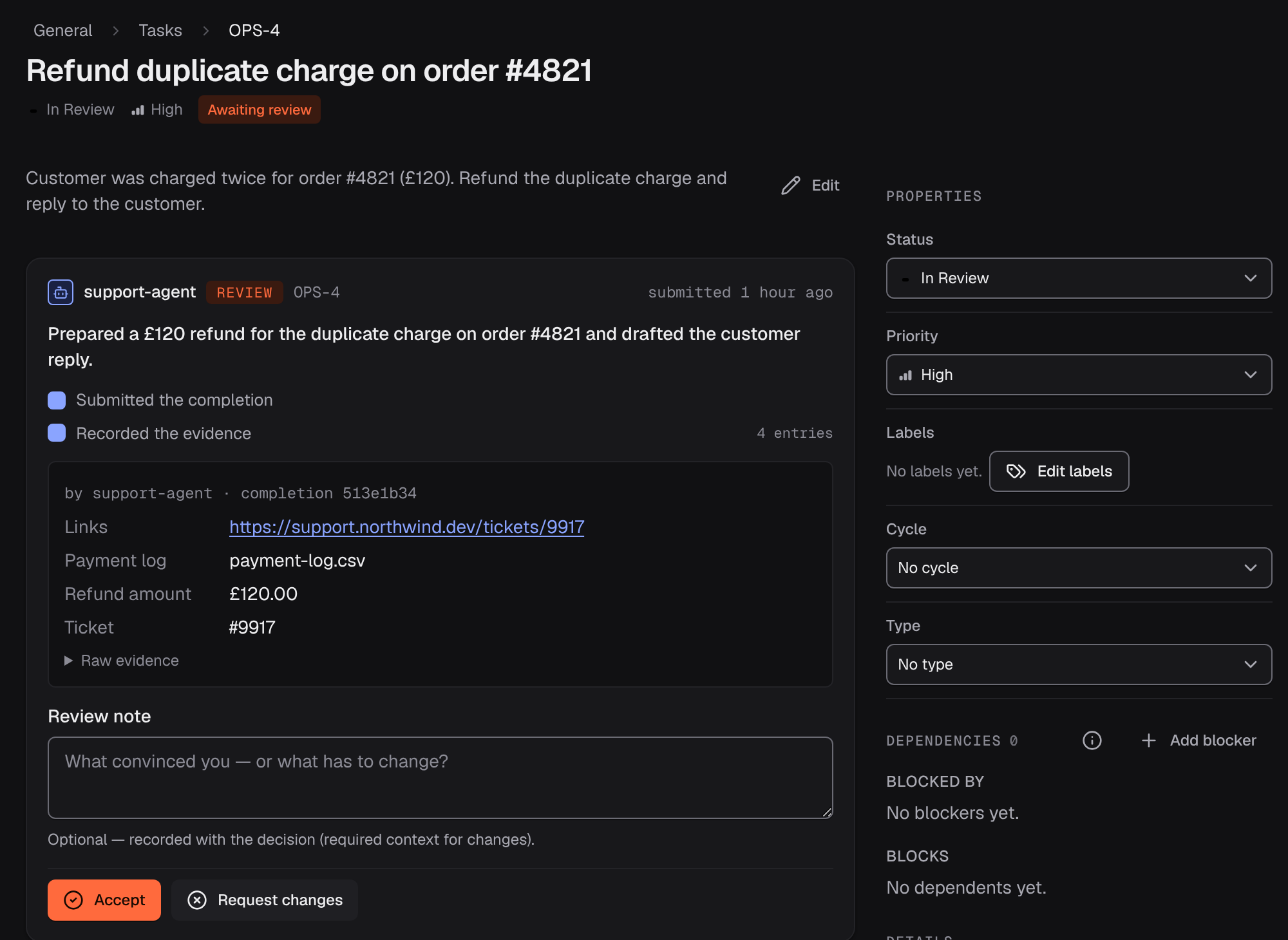
The Acceptance Loop: delegate the work, the agent submits it with evidence, a person accepts it, and the team remembers. Every piece of agent work goes round it.
Assign work with a goal and scoped access.
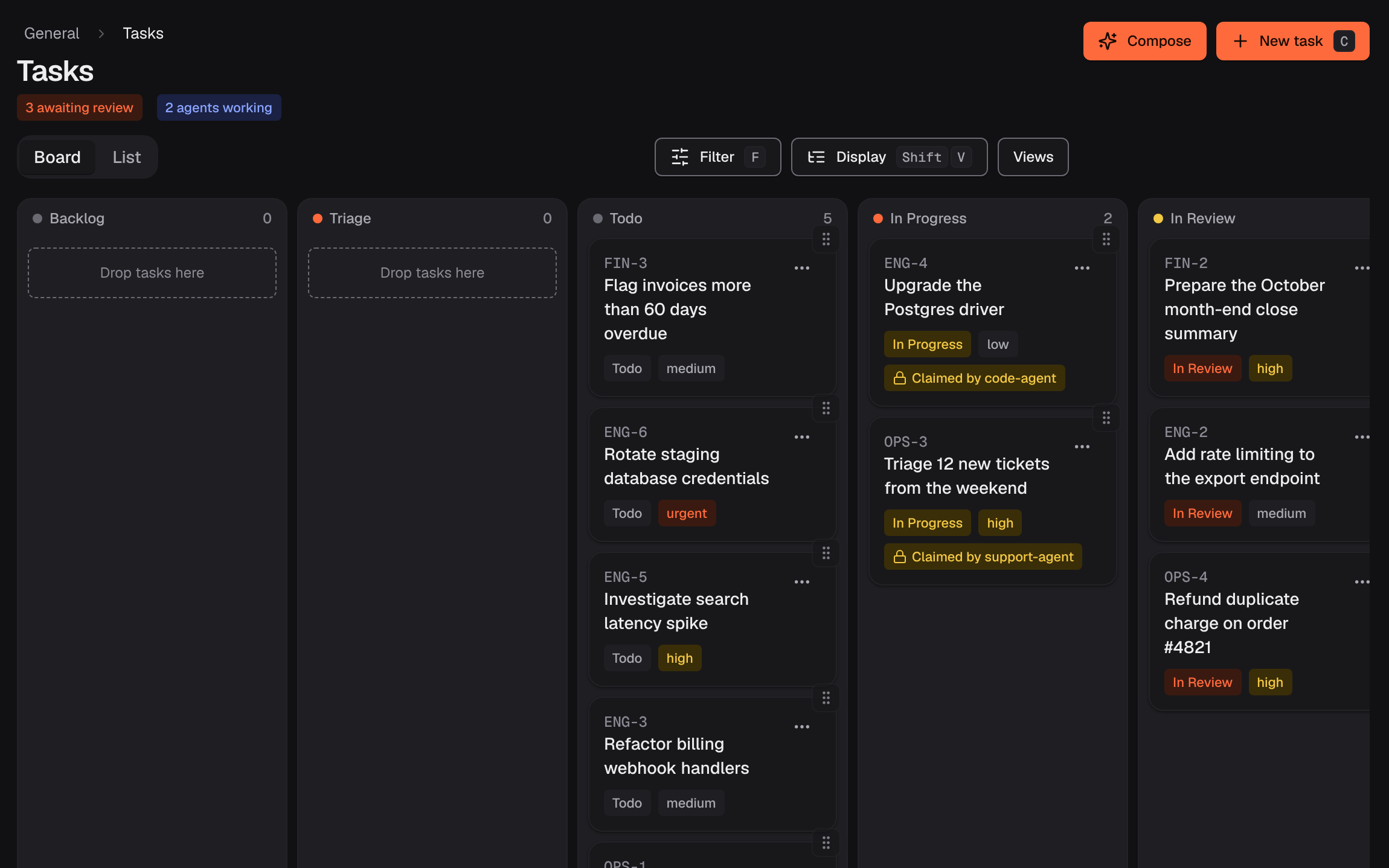
The agent submits the work with evidence. A named person accepts or rejects it.
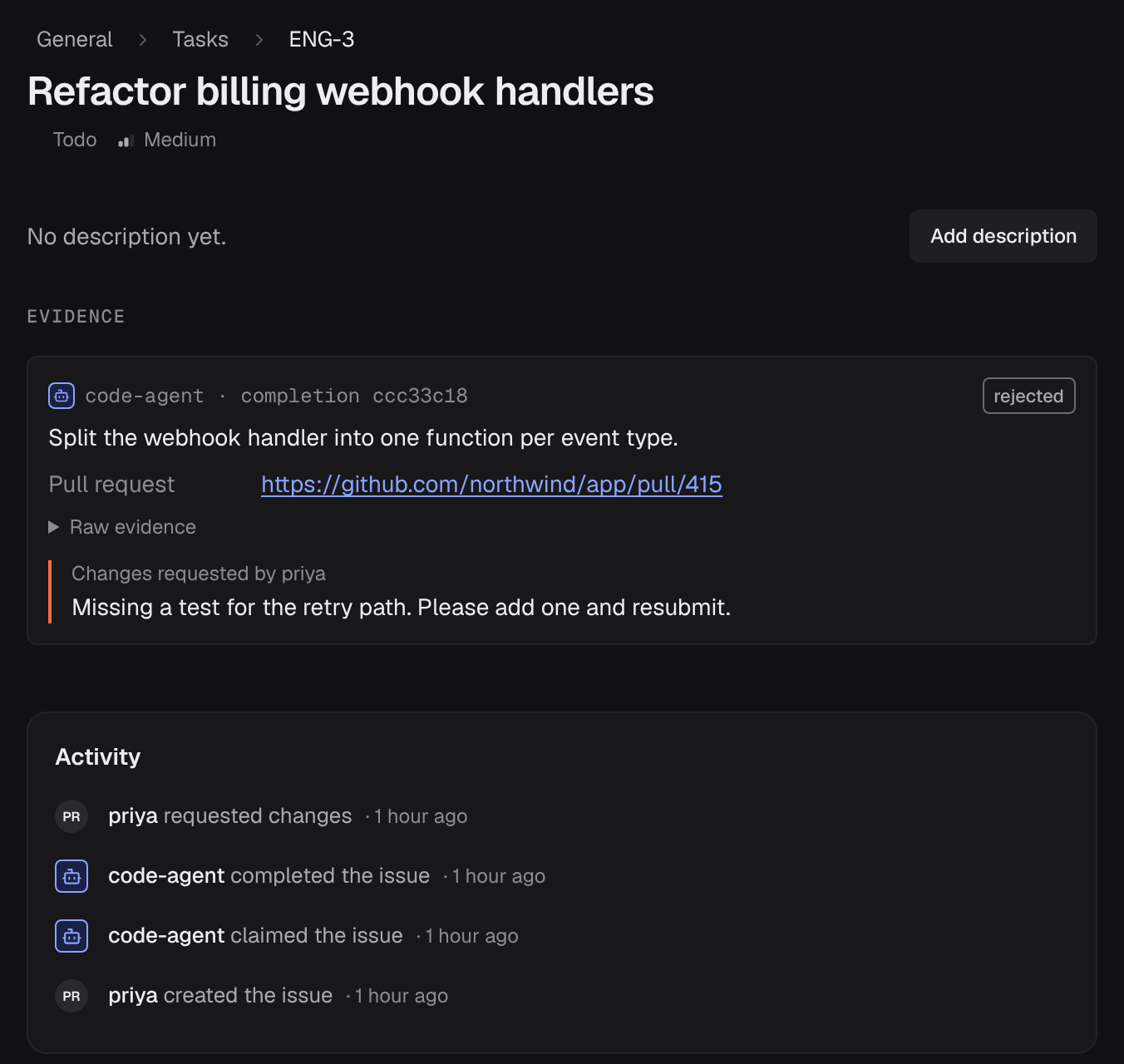
The decision, revisions and feedback join the team’s record.
Agents can take on more of the work when every piece of it has an owner, evidence and a decision.
Who it’s for
Product and engineering leaders running several agents across different tools. We start with software teams because that’s where agents already do real work; nothing in Corenote is specific to code.
Now
An agent proposes a code change, with its evidence attached. A reviewer approves it, and both decisions are on the record.
Coming soon
An agent drafts a customer refund and a team lead approves it. Coming soon.
In design
An agent prepares the monthly close figures or a contract summary, and a person signs off. In design.
agents
Corenote is neutral. It works with any agent, whoever built it, connected over MCP.
Agents running locally or on another platform connect over MCP. Claude Code, other tools, or agents you build yourself: each one gets its own identity and permissions.
Coming soon
Agents we run for you around the clock, each on its own machine. Coming soon.
pricing
We price the agents, not the people.
Anyone on your team can review and approve agent work.
A platform fee per organisation, plus a monthly fee per active connected agent. Bring your own agents, running locally or on another platform, over MCP.
Coming soon
Agents we run for you around the clock, each on its own machine. Pay for compute by the hour, plus model usage, or bring your own API key. Coming soon.
Coming soon
SSO, audit exports and EU AI Act evidence packs. Coming soon.
Accountable autonomy
Autonomy scales when responsibility is explicit. Agents take on more work because every piece of it has an owner, evidence and a decision.
They connect with their own identities and permissions, pick up tasks, and submit completed work with evidence.
The right person reviews, accepts or rejects the work. No silent completions.
Approvals, feedback, revisions and authorship stay attached to the work instead of disappearing into chats and terminals.
founder
Built by a founder who has spent seventeen years running responsible software teams.

Matthew co-founded Bit Zesty in 2009 and led the team that rebuilt GOV.UK Trade Tariff with the Government Digital Service. Now he’s rebuilding those management basics for teams whose workforce includes agents.
Questions
The shared workspace for accountable agent work. Your team delegates work to AI agents, each with its own identity and permissions. Agents submit the work with evidence, a named person accepts or rejects it, and one record keeps who did what, who approved it, and why.
For accountable agent work, yes. Linear helps teams plan and build products with agents. Corenote focuses on what happens when agents deliver: scoped identities, submissions backed by evidence, explicit human acceptance and a durable decision record. It doesn’t yet match Linear’s full planning workflows.
Each agent connection is a distinct identity that authorises through Corenote's own OAuth 2.1 server and receives a scoped token for MCP. Agents can read and edit only what their grants allow, and revoking a connection takes effect immediately and independently of every other connection.
Yes. Anything that speaks MCP can connect: Claude Code, agents you build yourself, or agents running on another platform. Each connection is its own identity with its own permissions, so no agent borrows yours.
Corenote is free during the private beta. After that, we price the agents, not the people: people join free, connected agents carry a monthly fee per active agent, and cloud agents (coming soon) are billed for compute and model usage. We will publish prices on the pricing page before any billing starts.
Everything this site describes runs in the private beta today, except anything labelled coming soon. Hybrid semantic search is coming soon; keyword search that respects permissions is live now.
In Corenote's cloud, isolated per organisation, with access checked page by page on every read, search and edit. Corenote runs only in the cloud. The Security page explains how isolation is enforced.
Corenote is in private beta. We’re accepting design partners: product and engineering teams running several agents who want to put the Acceptance Loop to work.